Saturday, November 30, 2013
Happy New Year!
From Rorate Caeli:
The new Liturgical Year begins today at 1st Vespers of the First Sunday
in Advent. As our readers know, the advent of the nativity of Our Lord
is a very special season for us, considering the name chosen for this
venue. We wish all of you and your families a very blessed new year and a
very blessed season of preparation for Christmas.
As an Advent and Christmastide gift, we will post in installments in the
upcoming weeks the new updated, corrected and revised version of the
great work first published by us in 2011: Don Pietro Leone Monselice's "The Roman Rite: Old and New", translated by our dear Francesca Romana.
Friday, November 29, 2013
Solemn Mass ’45 style!
From Fr. Z:
A reader sent me a note with a link to a movie (the whole thing on YouTube) called Christmas Holiday 1944.
From about minute 18 you will find a Solemn Mass. Very nice.
A reader sent me a note with a link to a movie (the whole thing on YouTube) called Christmas Holiday 1944.
From about minute 18 you will find a Solemn Mass. Very nice.
Sunday, November 24, 2013
The Awesomeness of the Novus Ordo!
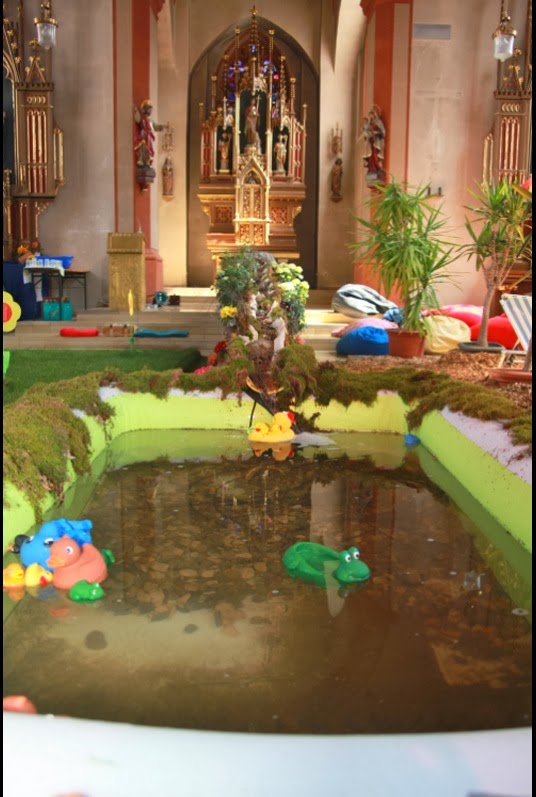
Stunningly beautiful new altars grace the Novus Ordo around Europe. We can only hope that this AWESOMENESS will cross the pond and into the U.S.
Heck, who needs those dusty old high altars anyway?
From Rorate Caeli:
From Rorate Caeli:
In the past few days this photograph has circulated among some Catholic blogs (and at least one Orthodox blog):
It shows Cardinal Marx spreading chrism on what surely has to be one of
the strangest altars ever consecrated for a Catholic church in the past
60 years.
This event, the consecration of this altar, actually took place in 2010 for Munich's Jugendkirche ("youth church"). More pictures of the event can be found here. The altar is not as light as it appears: it is made of galvanized bronze and weighs 160 kilos all in all.
Below we see the altar in use during a Youth Mass in 2011 led by Bishop
Engelbert Siebler, at that time an Auxiliary Bishop for Munich and
Freising (source):
Speaking of youth churches: all in all there are more than a hundred
Catholic "youth churches" in Germany, Austria, Switzerland and
Luxembourg. There is a website on the activities of the various Catholic
and Protestant "youth churches" in German-speaking lands: Jugendkirchen. There are no words to describe many of the pictures. For example:
Coming back to Cardinal Marx and his attitude to strange altars: he consecrated or will be consecrating 2 of them this month.
On the 10th of November, he consecrated a new altar for the Church of
the Annunciation in Traunstein-Haslach, one of the oldest parishes in
the Archdiocese of Munich and Freising, dating back to the 14th century.
(More photos here.)
Then on the 24th of November (today) he is scheduled to consecrate the following altar, for the church of St. Michael in Attel. According to the linked article, the altar is made of glass, with a metal framework inside.
These are no "isolated instances" but part of a wider trend that has not stopped at all in these past few years. This
is the continuing trend of permanently erecting deliberately "modern"
altars versus traditional and venerable altars, implanting dissonance,
rupture and ugliness in the middle of so many old churches in Europe.
This trend has continued and will continue, Benedict XVI or no Benedict
XVI, Francis or no Francis, with or without the blogs documenting them,
and despite the fantasies of some that insanity in liturgy and sacred
art is over.
To see more examples from Germany, the old version of Fides et Forma has a post with pictures of Archbishop Gerhard Müller consecrating five very "modern" altars as Bishop of Regensburg, all during the reign of Pope Benedict XVI, all in beautiful old Bavarian churches.
From France we have this blank-looking altar consecrated in May of this year for the 12th century Abbey of Leoncel, this monument to dissonance consecrated in 2011 for the 18th-century Sainte-Madeleine de Besançon, and this cramped little altar consecrated last year in the historical Église Sainte-Marguerite de Soppe-le-Haut. Want more? See this (from 2011), and this (the article doesn't say the year, but this was installed in the centuries-old Carmel of Angers in 2012), and this (the new altar, along with the new ambo and throne of the Gothic-style Cathedral of Nantes, consecrated in May of this year). And there are so many other examples on the Internet...
In neighboring Belgium, Archbishop Leonard of Malines-Brussels blessed a glass altar in 2012 in the splendid neoclassical (18th c.) Église Saints-Jean-et-Étienne-aux-Minimes in Brussels.
For examples from Italy, we have this cube altar consecrated only last month for a neoclassical church, a new asymmetrically designed altar consecrated in August this year for an 18th century church in Trent (!), and yet another cube altar of rough stone consecrated in December last year for the 16th-century parochial church of Montorfano.
The Gesù in Rome was not spared. This banality was installed only a couple of years ago, when Benedict XVI was Pope.
Rorate has other posts on this theme.
These aberrations can and will continue, as these are but symptoms of the profound dislocation of the sacred liturgy of the Roman Rite. This dislocation cannot be set right either by purely voluntary movements for the promotion of the sacred from among the clergy and the laity or by the "good example" and "encouraging words" of any Supreme Pontiff.
And the "Liturgical Art and Sacred Music Commission" that was supposed to have been set up in the Congregation for Divine Worship late in 2011? No one seems to have heard of it after its creation was announced... Has it already joined the long list of aborted liturgical projects from the last two pontificates?
To see more examples from Germany, the old version of Fides et Forma has a post with pictures of Archbishop Gerhard Müller consecrating five very "modern" altars as Bishop of Regensburg, all during the reign of Pope Benedict XVI, all in beautiful old Bavarian churches.
From France we have this blank-looking altar consecrated in May of this year for the 12th century Abbey of Leoncel, this monument to dissonance consecrated in 2011 for the 18th-century Sainte-Madeleine de Besançon, and this cramped little altar consecrated last year in the historical Église Sainte-Marguerite de Soppe-le-Haut. Want more? See this (from 2011), and this (the article doesn't say the year, but this was installed in the centuries-old Carmel of Angers in 2012), and this (the new altar, along with the new ambo and throne of the Gothic-style Cathedral of Nantes, consecrated in May of this year). And there are so many other examples on the Internet...
The new altar and ambo of Sainte-Madeleine de Besançon
In neighboring Belgium, Archbishop Leonard of Malines-Brussels blessed a glass altar in 2012 in the splendid neoclassical (18th c.) Église Saints-Jean-et-Étienne-aux-Minimes in Brussels.
For examples from Italy, we have this cube altar consecrated only last month for a neoclassical church, a new asymmetrically designed altar consecrated in August this year for an 18th century church in Trent (!), and yet another cube altar of rough stone consecrated in December last year for the 16th-century parochial church of Montorfano.
The Gesù in Rome was not spared. This banality was installed only a couple of years ago, when Benedict XVI was Pope.
Rorate has other posts on this theme.
These aberrations can and will continue, as these are but symptoms of the profound dislocation of the sacred liturgy of the Roman Rite. This dislocation cannot be set right either by purely voluntary movements for the promotion of the sacred from among the clergy and the laity or by the "good example" and "encouraging words" of any Supreme Pontiff.
And the "Liturgical Art and Sacred Music Commission" that was supposed to have been set up in the Congregation for Divine Worship late in 2011? No one seems to have heard of it after its creation was announced... Has it already joined the long list of aborted liturgical projects from the last two pontificates?
Saturday, November 23, 2013
"In 20 years, I've buried 120 priests and ordained only one"
If one could point to the primary reason the Church today has fallen off a cliff, look no farther then our bishops. Most of our Novus Ordo bishops could screw-up a one car funeral. Many are absolutely despicable men!
Here, courtesy of Rorate Caeli, we have a perfect example of a direct successor to Judas Iscariot. This complete buffoon, Archbishop Yves Patenôtre, can't figure out why he hasn't ordained more then one man over the past 20 years in his Archdiocese.
Simple answer: Real boys & real men want nothing to do with the feminized, protestantized Novus Ordo and "men" like him. Period.
Wake up Archbishop...and put on a collar.
Monseigneur Yves Patenôtre has been a bishop since 1994, and Archbishop of Sens-Auxerre (and Prelate of Mission de France) since 2004. And, in an article on a talk he had with a faithful who complained of giving to the Church's tithing campaign when he had not had a priest available for important moments of his life, Patenôtre wrote:
Here, courtesy of Rorate Caeli, we have a perfect example of a direct successor to Judas Iscariot. This complete buffoon, Archbishop Yves Patenôtre, can't figure out why he hasn't ordained more then one man over the past 20 years in his Archdiocese.
Simple answer: Real boys & real men want nothing to do with the feminized, protestantized Novus Ordo and "men" like him. Period.
Wake up Archbishop...and put on a collar.
Monseigneur Yves Patenôtre has been a bishop since 1994, and Archbishop of Sens-Auxerre (and Prelate of Mission de France) since 2004. And, in an article on a talk he had with a faithful who complained of giving to the Church's tithing campaign when he had not had a priest available for important moments of his life, Patenôtre wrote:
I told him what I often mention: "In almost twenty years of episcopate, I have buried one hundred and twenty priests, and I have ordained only one in the dioceses of Yonne [Sens] and the Jura [Saint-Claude, whose bishop he was from 1994 to 2004]."
And the article goes on with platitudes on how important it is to give
and that the Church's foundations are her priests, and that many who are
called are not willing to follow their vocation (all true, of course).
But his admission is an absolutely shameful thing for a bishop to say
because it is not joined by a public declaration of his grievous
personal fault for this state of affairs.
As we have always said, the crisis of the Church is indeed a crisis of bishops first of all.
Thursday, November 21, 2013
1st Traditional Latin Mass experience – “The highly pastoral nature of the Extraordinary Form.”
As much as I miss Pope Benedict XVI on the Chair of Peter, and as grateful as I will always be to him for trying to restore the Faith, I will never agree with a few things he did during his much too short pontificate:
1. I will never use the term "Extraordinary form of the Mass." Why? Terms such as "Traditional Latin Mass or TLM," "True Mass" and "Mass of the Ages" sums it up just fine.
2. I will never believe that the TLM and the protestant Novus Ordo are one in the same Mass. Wrong!
3. I will never believe that both the TLM and the Novus Ordo can be mutually rewarding to each other. Hogwash! Or in Marine terms: Just plain BS!
From Fr. Z this morning:
1. I will never use the term "Extraordinary form of the Mass." Why? Terms such as "Traditional Latin Mass or TLM," "True Mass" and "Mass of the Ages" sums it up just fine.
2. I will never believe that the TLM and the protestant Novus Ordo are one in the same Mass. Wrong!
3. I will never believe that both the TLM and the Novus Ordo can be mutually rewarding to each other. Hogwash! Or in Marine terms: Just plain BS!
From Fr. Z this morning:
Over the past 10 years have assisted at a few dozen EF masses. I usually go alone and sometimes with my very Catholic friends, but this weekend I took a group of high school students and their parents. For all, this was their first EF experience.Most were less than enthusiastic going into it (don’t understand the language, priest facing the “wrong way,”), but afterward they were excitedly making plans for the next time they could all get together and do this again.I heard a lot of the expected reactions, e.g. more reverent, “holier”, more intimate. What struck me was the varied approaches each one took toward the Mass. Each of the parents and students were all over the map personality wise, spiritually, and intellectually, but they all intuitively found a place for themselves and participated enthusiastically. Some insisted on following the missal the entire time, while others (who came in a different car and I didn’t get the chance to give them any heads up as to what to expect) did not even pick up a missal. Some embraced the challenge of trying to understand this or that prayer or gesture, others didn’t. No one had trouble following along.For me, the EF had always been an occasional refuge from our poorly organized and largely uninspiring weekly OF mass, and, if attending with my friends, it felt like the “big boy” mass; something for those with a good theological education and a good deal of enthusiasm for the Church in general. My experience today prompted me to reflect on the highly pastoral nature of the EF.Throughout my theological training (graduate level) it was constantly impressed upon us that we should “meet people where they are,” and that we should be prudent about engaging people on the more difficult Church teachings. Today I was impressed by how the EF did these things, and did them so “effortlessly”. I and the rest of our pastoral team have frequently bent over backwards in an attempt to meet people where they’re at; with the EF, it happened, seemingly, without anyone even trying. The Church did it all for us.I hope I get the chance to assist at many EF Masses in the future, but I will no longer look on it as the Mass for the advanced. There’s truly something for everyone there!
Tuesday, November 19, 2013
The Remnant Underground
Michael Matt and Christopher
Ferrara, down
in the catacombs, discuss
religious liberty
and Pope Francis.
Why the Traditional Latin Mass?
From The Remnant:
| Father Michael Rodriguez | |
| Guest Columnist | |
| ______________________ | |
|
The Only
Mass Padre Pio Ever Offered
(1) The venerable
and immemorial Roman Mass, including in its exquisite
ritual detail, is theocentric—centered on and
directed to Almighty God. It gives constant glory to
the Triune God: a sacrifice of adoration, thanksgiving,
propitiation, and impetration, directed to God,
both theologically and ritually.
(2) The venerable
Roman Mass (Traditional Latin Mass) is the “Mass of the
Ages,” it is the Mass which has always been
offered by the one, holy, Catholic Church. Thus, it is
the true and proper Catholic Mass. This is the Mass
which has been handed down by the tradition of Rome,
the city consecrated by the blood of two princes, the
holy apostles, St. Peter and St. Paul. It is the
masterpiece of two-thousand years of Catholic
Tradition, life, and worship.
(3) By means of the
Traditional Latin Mass we are able to be supremely
faithful to our Catholic religion, i.e. faithful to
the (exact same) law of belief (lex credendi) and
the (exact same) law of prayer (lex orandi) which
have been professed by all our ancestors in the Faith,
stretching back to the Apostles themselves.
(4) The venerable
Roman Mass, including in its exquisite ritual detail,
professes, manifests and honors the ineffable Mystery
which takes place: Jesus Christ, the one High Priest,
offers the sacrifice of His life, through the ministry
of His priests, in an unbloody manner. Our Redeemer
returns mystically to die for us.
(5) The venerable
Roman Mass, including in its exquisite ritual detail,
professes, manifests, reverences, and adores the
ineffable Mystery which takes place: the Body
and Blood of Jesus Christ, together with His Soul and
His Divinity, are made present and real through the
Miracle of Transubstantiation at the time of the
Consecration.
(6) It is a Dogma of
the Catholic Faith that the worship of Adoration (latria)
must be given to Christ present in the Eucharist. The
venerable Roman Mass, including in its exquisite ritual
detail, carries this out to perfection.
(7) The venerable
Roman Mass highlights the fact that Holy Mass is
Christ’s own sacrifice, holy, perfect, and in every
point complete, through and with which each one of the
faithful nobly honors God, confessing at one and the
same time one’s own nothingness and the supreme dominion
which God has over one.
(8) The classical
Roman Mass is unchanging. It is characterized by
a holy permanence and stability. This is extremely
important because it is a reflection of the lex
credendi (the Faith) which does not change. God is
immutable, the holy truths of the Catholic Faith are
immutable, Holy Scripture is immutable . . .
Holy Mass is immutable.
(9) The classical
Roman Mass is universal. It unites us not only
with all the Catholics of the world (space) but also
with all our Catholic ancestors across the centuries
(time), especially the throngs of saints whose souls
were nourished and strengthened by this very same
heavenly Liturgy.
(10) Our Ancient
Rite expresses the Roman Catholic Faith clearly, fully,
and with sublime beauty and noble precision, e.g. the
mysteries of the Blessed Trinity and the Incarnation,
the holiness and grandeur of Almighty God, the mystery
of grace and reality of sin, the veneration of the
Blessed Virgin Mary, the angels and the saints, the Mass
as the Sacrifice of Christ offered to the Eternal Father
for our salvation, the priesthood as a perpetuation of
Christ’s own Priesthood, the hierarchical nature of the
Church, death, judgment, heaven, and hell.
(11) The venerable
Roman Mass professes, manifests, and extols the
following effects of the Holy Sacrifice of the Mass:
the most Blessed Trinity is adored, honored, and
glorified, Jesus Christ renews His Death on the Cross,
Jesus Christ intercedes for the Church, the Virgin Mary
and the saints are honored, the Church is aided in its
battle against the devil and in its effort to reach
heaven, the holy souls in purgatory are freed.
(12) The orations
(prayers) of the Traditional Latin Mass express,
transmit, and extol Catholic doctrine, e.g. Catholic
teaching on hell, divine judgment, God’s wrath,
punishment for sin, the wickedness of sin as the
greatest evil, detachment from the world, purgatory, the
souls of the departed, Christ’s kingship on earth, the
Church Militant, the triumph of the Catholic Faith, the
evils of heresy, schism and error, the conversion of
non-Catholics, the merits of the saints and miracles.
| |
Monday, November 18, 2013
Francis endorses the "hermeneutic of reform in continuity"
From Rorate Caeli:
Papal letter praises critic of "Bologna School" as "best interpreter of the Second Vatican Council"
In his latest post
for his personal blog, Sandro Magister publicized the text of a letter
sent by Pope Francis to Abp. Agostino Marchetto, a former Secretary of
the Pontifical Council for the Pastoral Care of Migrants and Itinerant
People. He is best-known as the author of The Second Vatican Ecumenical Council: A Counterpoint for the History of the Council, which
criticizes the "Bologna School' and champions the "hermeneutic of
reform, of renewal in continuity" as proposed by Benedict XVI, most notably in his speech of December 22, 2005.
Also striking is the thanks directed to Archbishop Marchetto for having corrected an unspecified "mistake or imprecision" of Pope Francis.
Here is Rorate's translation of the letter, with our emphases:
Also striking is the thanks directed to Archbishop Marchetto for having corrected an unspecified "mistake or imprecision" of Pope Francis.
Here is Rorate's translation of the letter, with our emphases:
Dear Abp. Marchetto,
With these lines I wish to be close to you and join myself to the act of presentation of the book “Primato pontificio ed episcopato. Dal primo millennio al Concilio ecumenico Vaticano II” [Pontifical primacy and epicopate: from the first millennium to the Second Vatican Ecumenical Council"]. I beg you to consider myself spiritually present [there].
The topic of the book is an homage to the love that you have for the Church, a loyal and at the same time poetic love. Loyalty and poetry are not an object of trade: they cannot be bought or sold, they simply are virtues that are rooted in the heart of a son who feels the Church to be a Mother; or, in order to be more precise, and saying it with an Ignatian familiar "tone", as "the Holy Mother the hierarchical Church".
You have made this love manifest in many ways, including correcting a mistake or imprecision on my part - and for that I thank you from the heart -, but above all it is manifest in all your purity in the studies made on the Second Vatican Council. I once told you, dear Abp. Marchetto, and I wish to repeat it today, that I consider you to be the best interpreter [ermeneuta] of the Second Vatican Council.
I know that this is a gift from God, but I also know that you made it bear fruit. I am grateful to you for all the good that you do for us with your testimony of love for the Church, and I ask the Lord that you be abundantly blessed.
I beg you please not to forget to pray for me. May Jesus bless you, and may the Virgin protect you.
Vatican, October 7, 2013
Fraternally,
Francis
In The Old Mass Did The Priest Really Turn His Back On The People?
“In the old
days the priest said Mass with his back to the people.” The priest never had his back to the people. When churches began to be built in the early
centuries of Church history, they were constructed in such a way that when the
priest offered Mass he would be facing east.
The people would face east as well.
Priest and people would face east together. If east on a compass was impossible, priest
and people would face “liturgical east”. Facing east together was what was most
important.
What is so important about facing
east? First, the sun rises in the
east. The rising sun of the universe
would be a reminder of the risen Son who created the universe. Nature itself speaks to us, remind us of the
resurrection of Christ. Second, there is
a tradition that when Christ returns at the end of the world, He will come from
the east. Saying Mass with both priest
and people facing east is a way for us, His people, to be ready and waiting to
meet Him when He comes. It is a way to
express eager expectation of His return.
(Some cemeteries even bury the dead and have headstones facing east for
the same reason). At Christmas, the Wise
Men saw the Star of Bethlehem rise in the east to announce the Messiah’s
coming. A sign in the sky from the east
will also announce the Messiah’s second coming.
| Graves facing the east awaiting the Messiah's return |
The reason why priest and people faced
the same direction during Mass also relates to the specific role of the
priest. The priest is the spiritual
leader of the people. The priest is
entrusted with being like a good shepherd, who helps lead and guide the flock
towards Christ. Since Christ will come
from the east, it makes perfect sense that both the priest and people turn
together towards the east, and that the priest be out in front leading the
flock toward their ultimate Good Shepherd.
General George Washington always got out in front of his soldiers and
led them in battle. No soldier complained
about Washington having his back to them as he led them in battle. Similarly, no one complains when a pilot, the
leader of passengers, has his back to the people when he pilots the plane. They are happy he is focused on their
destination. The priest is like a
general or a pilot, in that he is a spiritual leader of the people. It makes sense that both priest and people
face towards the east together, and that the priest lead them to their ultimate
destination, to God.
Other things to consider: When the
priest and people face the same direction, their souls and bodies are oriented where
they should be – towards the Lord. When
the priest and people face each other, a danger that could occur is that
instead of being focused on God, the priest and people are focused in on each
other and Mass can become worship of self and of human achievement, rather than
a worship of God and focus on Him alone.
Today, with priest and people facing each other, how often is there
applause during Mass for some human accomplishment? How often is Mass focused on a specific group
of people? How often did this occur when
the priest and people faced the same direction and focused on God alone?
| Take your pick ... This one |
With priest and people facing each
other, the priest can subconsciously feel he is on a stage, rather than in a
sanctuary and that he has to try to be humorous or somehow interesting to the
people. When the priest faces the same
direction as the people, his face is unseen and his individuality is
diminished. This helps the people and the priest. It helps the people focus on God alone and
helps the priest suppress his own personality, driving home that he is a slave of
God and the Mass, not the main character in a stage production.
“In the old days the priest said Mass
with his back to the people.” Absolutely
false! This gives the impression that
the priest was haughty or that the people were excluded. Rather priest and people faced the same
direction, faced towards the Lord.
| Or this one? |
Wednesday, November 13, 2013
Tuesday, November 12, 2013
Cardinal Bartolucci (RIP)

Dominicus Card. Bartolucci
vii Maii MCMXVII - xi Nov. MMXIII
Cardinal Bartolucci on the Traditional Latin Mass, August 12, 2009 (from The Remnant)
A bombshell of an interview. Mons. Domenico Bartolucci on the liturgical reforms and the reform of the reform.
From the remarkable Italian Catholic blog, Disputationes Theologicae:
The
liturgical reform of the 1970-ies is today taking up much space in the
theological discussions, because liturgy and theology are mixed up in a –
may we venture to say so – “transcendental relation”. It is not
possible to discuss the one without taking up the other, if one does not
want to fall into that theology of watertight compartments that was in
use in the 1950-ies. Today it is necessary – in the wake of a more vast
debate in which we engage ourselves – to formulate an open and
straightforward analysis of what has happened and take an appropriate
attitude towards the practical remedies and above all remedies that are
“realizable” (realizzabili) as Saint Pius X used to repeat. Upon the
request of so many of our readers, our Editorial Office also would like
to occupy itself with the argument, if possible avoiding the repetition
of the methodological errors of the past. Therefore it is our wish to
initiate the true transmittance of the authentic Tradition.– basing
ourselves on the testimony of those who have known the past, because of
their age and their prestige, and not only because of their authority.
As liturgy is also practical science, we have not wished to start off
with pontificating “liturgists” who say they have read so and so many
books and codices, but rather take the matter up with someone who has
lived and touched the liturgy as nobody else has, because he has
prepared, repeated, coordinated and known the religious ceremonies in
his Tuscan countryside, ceremonies which concluded with the “Messa in
terza” (a mass celebrated by three i.e. Solemn Mass -- CAP)
and the unfailing processions with a musical band, as well as the
splendors of the “Cappella Papale” in the Sistine chapel. We have the
honor of introducing to you Monsignor Domenico Bartolucci, in an
interview done by us lately. He was born in 1917 in Borgo San Lorenzo
(Florence)., Tuscan by birth, Roman by pontifical summons, in 1952 he
became substitute next to Perosi in the Sistine Chapel and from 1956 he
became its Maestro Perpetuo. On the 24th of June, 2006 the reigning
pontiff organized a special ceremony in honor of the musician (see the
picture above), in order to consecrate “ad perpetuam rei memoriam” his
closeness to the great master. During the occasion the Pope said: “
sacred polyphony, especially the one belonging to the Roman school, is a
legacy which we must preserve with care (..); a genuine updating of the
sacred music can only take place within the great tradition of the past
of the Gregorian chant and of the sacred polyphony”. S.C.
INTERVIEW WITH MONSIGNOR. DOMENICO BARTOLUCCI
by Pucci Cipriani and Stefano Carusi
A
meeting with Monsignor Domenico Bartolucci, the distinguished Mugellan
musician, Maestro Emeritus of the Sistine Chapel, admirer, friend and
collaborator of Benedict XVI.
It
is a sunny afternoon on the green hills of the Mugellan landscape, when
we arrive on the Roman church of Montefloscoli, in the antique rectory
full of memories the Maestro Perpetuo of the Sistine Chapel is enjoying
the fresh air, behind him a framed photo of the hug the reigning pontiff
is giving Monsignor Domenico Bartolucci, the successor of Lorenzo
Perosi in the Sacred Palace. On his writing-desk the now-famous book of
Monsignor Brunero Gherardini: “Il Concilio Vaticano II- un discorso da
fare” (“The Second Vatican Council – a debate to be started”), edited by
Edizioni Casa Mariana.
It
is on the subject of the liturgical reform that we start our
conversation with the Maestro, with Domenico Bartolucci, who in
liturgical and musical matters has been at ease working and giving
counsel to five popes and who is a friend and collaborator of Benedict
XVI, whose work he says is “an immense gift to the Church, if only they
would let it work”.
Maestro,
the recent publication of the Motu proprio “Summorum Pontificum” has
brought a gust of fresh air into the desolate liturgical panorama which
surrounds it. Even you may now celebrate the Mass of all time (“messa di sempre”.)
To tell the truth, I have always and without interruption celebrated it since my ordination … on the contrary, I sometimes found it difficult to celebrate according to the modern rite, even if I never said so.
The Mass which never was abolished, is it not?
Those
are the words of the Holy Father even if some people pretend not to
understand and even if many in the past have argued that the opposite is
true.
Maestro, you have to admit to those who are denigrating the old Mass that it is not a Mass open to participation.
So
that you won't think that I'm just saying anything, I know how
participation in old times was like, both in Rome, in the (St. Peter's)
Basilica and outside it, for instance down here in Mugello, in this
parish, in this beautiful countryside, which was then populated by
people strong in faith and full of piety. During Sunday Vespers
the priest could just start singing “Deus in adiutorium meum intende”
and thereafter fall asleep on his seat to wake up only at the “chapter”,
the peasants would have continued alone and the heads of the family
would have intoned the antiphon!
Do we see a veiled polemic, Maestro, in your confrontation with the current liturgical style?
I
do not know, if you have ever been at a funeral and witnessed those
“hallelujahs”, hand-clapping, giggly phrases, etc. One really asks
oneself if these people have ever read the Gospel. Our Lord himself
cried over Lazarus and his death. Here now, with this oily sentimentalism, nothing is respected, not even the suffering of a mother.
I would like to show you how the people in old times participated in a
Funeral Mass and how in the midst of that compunction and devotion, the
magnificent and tremendous “Dies Irae” was intoned.
Was
the reform not done by people who were conscious of what they were
doing and well educated in the teachings of the Roman Church?
I beg your pardon, but the reform was done by arid people, arid, arid, I repeat it. And I knew them. As for the doctrine, Cardinal Ferdinando Antonelli himself, once said, I remember it well: “What are we to make of liturgists who know nothing about theology?”
We agree with you, Monsignore, but is it not true that the people did not understand….
Dearest
friends, have you never read Saint Paul: “It is not important to know
anything but what is necessary”, “it is necessary to love knowledge ad sobrietatem”.
At this rate, after a few years people will pretend to understand
“transubstantiation” in the same way as they explain a mathematical
theorem. But just think of it that not even the priest may quite
understand this mystery!
But how could it have come to this twisting of the liturgy?
It became a kind of fashion. Everybody talked about it, everybody “was renewing”, everybody was trying to be like popes (tutti pontificavano) in the wake of sentimentalism, of eagerness to reform. And the voices that raised themselves to defend the two thousand year old Tradition of the Church, were cleverly hushed. There
was the invention of a kind of “people’s liturgy” … when I heard these
refrains, it came into my mind something which my professor at the
Seminary used to say: “the liturgy is something given by the clerics to
the people” (“la liturgia è del clero per il popolo”). It descends from God and does not come up from the bottom. I have to admit, however, that this foul-smelling appearances have made themselves a bit more rare. The
young generations of priests are maybe better than those who came
before them, they do not have the ideological fury of an iconoclastic
ideology, they are full of good feelings, however they lack in education.
What do you mean, Maestro, when you say “they lack in education”?
It means that they need it! I am speaking of the structure that the wisdom of the Church had so delicately chiseled in course of centuries. You do not understand the importance of the seminary: a liturgy that is fully lived, the orderly articulation of the different periods of the year and all this experienced in social communion with the brothers... Advent, Lent, the big feasts that follow after Easter. All of this is educational and if you only knew how much!
A foolish rhetoric wants to depict the seminary as something which spoils the priest, that the seminarians, remote and far away from the world, remain closed in themselves and distant from the people. This is pure imagination, invented by people who wish to dissolve an age-old formative richness and replace it with emptiness.
Let
us return to the crisis of the Church and to the fact that so many
seminaries have closed down, do you, Monsignore, support a return to the
continuation of Tradition?
Look
here, to defend the old rite is not the same as being a worshipper of
ancient times; it is to be “eternal”. You see, when one gives the
traditional mass names like “Mass of Saint Pius V” or “Tridentine” one
is wrong, it makes it seem as if it is a mass belonging to a certain
epoch. It is our Mass, the Roman universal Mass, valid
everywhere and in all times, a single language spoken from the Oceania
to the Arctic’s. Concerning the continuity in time, I would
like to tell you an episode. Once we were together with a Bishop whose
name I forgot, in a small church in Mugello, when there came the sudden
notice that a brother of ours had died. We suggested that we at once
celebrate a Mass, but then we realized that we only had old Missals at
hand. The Bishop refused categorically to celebrate. I will never forget
it and I repeat that the continuity of the liturgy means that –
except for small details – it can be celebrated today, with that old
dusty missal standing on a bookshelf and which for four centuries or
more has served my predecessors.
Monsignore, there is much talk about a “reform of the reform” which could take away the deformities that came in the 70-ies.
The
question is rather complicated. That the new rite had deficiencies is
by now becoming evident for everybody, and the Pope has many times said
and written that we must “keep what is ancient” (guardare all'antico). However
we must beware of the temptations of introducing hybrid measures. The
liturgy with a big “L” is the one that comes to us from centuries back,
it is the reference, it is not the debased liturgy which holds so many
compromises “that make God sad and the enemy happy” ("a Dio spiacenti e a l’inimici sui”)
What do you mean, Maestro?
Let
us for instance take the innovations in the seventies. Some ugly songs
in beat that were in vogue in the churches in 1968, are today already
archeological pieces. Giving up perennity and emerging oneself in time,
means that one is condemned to the fads of fashion. In this
connection I come to think of the Reform of the Holy Week in the 1950's,
made with some hurry under the pontificate of a Pope Pius XII who was
already exhausted and tired. Only some years later,
under Pope John XXIII who in liturgical matters was of a convinced and
moving traditionalism, came a telephone call to me from Mons. Dante,
Master of Ceremonies of the Pope, who told me to prepare the “Vexilla
Regis” for the coming celebration on Good Friday. I was somehow taken
aback and answered: “They have forbidden me to do it”. The answer was:
“But the Pope wishes it.” In a few hours I organized the repetitions of
the songs and very happily we sang again the same songs which the Church
had sung in many centuries on that day. All this only to say
that when one distances oneself from the liturgical context those voids
become difficult to fill and you can be sure they are noticed! In
front of our liturgy of many centuries we should contemplate it and
venerate it and remember that in our mania for “improvements”, we only
risk doing great damage.
Maestro, what role does music play in this process?
It has an incredibly important role for many reasons. The affected “Cecilianism” to which certainly Perosi was no stranger, with its tones that were so mild and enticing to the ear had introduced a new romantic sentimentalism, which had nothing to do, for instance, with the eloquent and solid physicality of Palestrina. Some extravagant deteriorations introduced by Solesmes had cultivated a subdued gregorianism, which also was the fruit of a pseudo-restauring passion for the Medieval ages, which were so popular in the nineteenth century.
The idea of an opportunity to recuperate the archeological vein, both in music and liturgy, of a past, from which the so called “oxen centuries” (seculi bui) of the Council of Trent separated it ….. in short an archeology which has nothing at all to do with Tradition and which wishes to restore something which maybe never existed, is a bit similar to certain churches restored in the “pseudoromantic” style of Viollet-le-Duc.
What does it mean, Monsignore, when in the musical field you attack Solesmes?
This
means that the Gregorian chant is modal, not tonal and not rhythmical,
it has nothing to do with “one, two, three, one, two, three”. We should not despise the way people sung in our cathedrals and replace it with a pseudo-monastic and affected murmuring. A song from the Middle Ages is not interpreted with theories of today, but one should go about it as it was then. Moreover
the Gregorian chant of another historical time could also be sung by
the people, sung using the force with which our people expressed their
faith. Solesmes never understood this, but we should recognize
the learned and great philological work executed on the old manuscripts.
Maestro, how far have we come in our days with the restoration of Sacred Music and the Liturgy?
I cannot deny that there some signs of restoration, but I still can see that there persists a certain blindness, almost a complacency for all that is vulgar, coarse, in bad taste and also doctrinally temerarious. Most important, do not ask me, please, to make a judgement on the guitar-players and on the tarantellas which are sung during the Offertory.….The liturgical problem is serious, do not listen to the voices of those persons who do not love the Church and who oppose the Pope and if you want to cure the sick then remember that the merciful doctor makes the wound purulent (fa la piaga purulenta).
Cardinal assures Una Voce that Pope won't touch Traditional Mass status
From Rorate Caeili:
The General Assembly of the International Una Voce Federation (FIUV) was
held in Rome in the past few days - and they got an uplifting visit
from Cardinal Castrillón:
The former prefect of the Congregation for the Clergy has told a traditionalist group that Pope Francis has no intention of restricting access to the Extraordinary Form of the Latin liturgy.
“I met Pope Francis very recently and he told me that he has no problem with the old rite, and neither does he have any problem with lay groups and associations like yours that promote it,” Cardinal Dario Castrillon Hoyos told members of Una Voce International (FIUV), who were in Rome for a general assembly.
Responding to questions from FIUV members about tensions within the Friars of the Immaculate, the Colombian cardinal said that the Pope moved to insist on the use of the Novus Ordo in that religious community only because of internal dissension, and not because of any negative judgment on the traditional liturgy (Yea, right! And pigs can fly?).
At its general assembly, FIUV elected a new president: James Bogle, a lawyer, author, and chairman of the Catholic Union of Great Britain. “We are very grateful to His Eminence Cardinal Castrillon Hoyos, His Eminence Cardinal Brandmüller, and to Archbishop Pozzo for taking part in our General Assembly of the International Federation Una Voce,” Bogle said in a brief statement to CWN. “We are very pleased with the way the celebration of the traditional Mass is now going worldwide. We are obviously very grateful to Benedict XVI and also our present Pope Francis for all the support that they have given us in our right to worship in the traditional Roman rite.”
Subscribe to:
Posts (Atom)