| By Alberto Carosa | |
| Rome Correspondent | |
| ______________________ | |
|
10/10/13--The
CISP (International Coordination Summorum Pontificum)
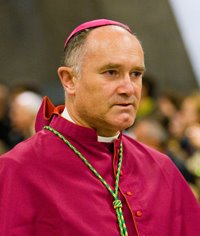
has announced that His Eminence Dario, Cardinal
Castrillón Hoyos will be celebrating Pontifical High
Mass in St Peter’s Basilica on Saturday 26 October at 11
o’clock during the pilgrimage of the people of Summorum
Pontificum to Rome.
Holy Mass on 26 October will allow Diocesan and
Religious Priests, Seminarians, and the faithful among
the people of Summorum Pontificum to show Cardinal
Castrillón Hoyos their gratitude and affection for
everything he has done in the service of the Church,
especially at the time of the preparation of the Motu
Proprio Summorum Pontificum, during which His Eminence
was a witness and of which he is the living memory.
The CISP especially wishes also to express their
gratitude to His Eminence for coming to say Mass,
especially since the 26th of October is the
sixty-first anniversary of his ordination to the
Priesthood, which he received in the Basilica of the
Holy Apostles in Rome on 26 October 1952.
This Pontifical High Mass of thanksgiving at St Peter’s
will be one of the central points of the Pilgrimage,
during which the eternal youth of the Extraordinary Form
of the Roman Rite will be seen by all, and by means of
which the people of Summorum Pontificum will contribute
to the missionary zeal of the New Evangelization.
This is the fifth pontifical in the extraordinary rite
to be celebrated in St Peter’s Basilica since the
promulgation of the motu proprio Summorum Pontificum in
2007, and the second one personally celebrated by His
Eminence Dario Castrillón Hoyos, after his first
celebration on November 5th, 2011, on the occasion of
the General Assembly of Una Voce-FIUV in Rome. In his
homily the Cardinal forcefully decried “the widespread
practice of liturgical abuses in the aftermath of the
Council” as having produced “deep wounds in the Church”
and blamed what he termed the so-called “spirit of the
Council” for being exploited as “a tool to uphold
spurious claims often aimed at imposing disturbing ways
of thinking and acting” (Cf. Vatican Insider, 5 November
2011).
This senior prelate is also on record for having been
probably the staunchest supporter of Benedict XVI in his
efforts to reinstate the old rite, which the Cardinal
aptly said should be more correctly called the Gregorian
rite. All the more so if we consider that he did not
limit himself only to preach but also practiced what he
was preaching, and his forthcoming celebration in St.
Peter’s will be only the latest among many occasions on
which he celebrated the Gregorian rite.
“It was a real nightmare putting the Summorum Pontificum
into practice”, Cardinal Castrillon Hoyos painfully
recalled during a book presentation on the opposition to
Summorum Pontificum in late 2011 (cf. Vatican Insider,
October 2011). This gives us an idea of what he had to
endure and how daunting the task was, especially because
opposition to the Motu Proprio is rooted in ignorance,
he claimed, “of what we have lost and theologically
should be viewed in light of the Holy Ghost’s action
through the successor of Peter. And the Holy Father
wanted to give back to the world such great treasure,
the enormous spiritual richness of the ancient liturgy,
a powerful tool of sanctification”.
A treasure which is a gift of God and therefore should
be made available not only to traditional minded
church-goers or the groups who were asking for it, but
to all the faithful, and here again we should be
grateful to the great courage of the Cardinal, who on 14
June 2008 forcefully told a press conference in London
that Pope Benedict would not like to see only “many
ordinary parishes” celebrating the Gregorian Rite, but
“all the parishes”, which demands that all seminarians
be taught how to celebrate it.
This has to be seen against the backdrop of Cardinal
Castrillon Hoyos, that very same day, celebrating a
solemn pontifical in the Gregorian rite in the Cathedral
of Westminster for the first time in three decades. To
give an idea of the above “nightmare”, neither the
archbishop of Westminster Cardinal Cormac
Murphy-O'Connor nor any other incumbent bishops were in
attendance. The cathedral itself, however, was bursting
at the seams, with over 1,500 faithful including so many
young families in attendance. At that time, over sixty
young priests from around the country had joined a
summer course offered by Merton College in Oxford to
learn how to celebrate the Gregorian rite.
On another occasion, His Eminence is on record for
having described as a “time of grace” the period “that
we are living since the enforcement of the motu proprio
Summorum Pontificum of the Holy Father Benedict XVI”
(cf. Vatican Insider, 4 November 2012).
All of this is precisely the spirit in which we are
called to live
the second pilgrimage of the people of Summorum
Pontificum to Rome, due in 24-37 October 2013, to cap
the Year of Faith.
| |
Monday, October 14, 2013
Cardinal Castrillón Hoyos to Celebrate Pontifical in the Basilica of St. Peter in Rome
From The Remnant:
Captain Phillips
Spent the afternoon watching another great Tom Hanks movie, "Captain Phillips." Although several of his real life shipmates are now coming out of the woodwork to discredit him, it's still worth watching.
Once again, the U.S. Military (in this case, SEAL Team-6/Dev Group) show that speed, surprise and violence of action tend to work, every time.
If you have not had a chance to see it, don't wait for the DVD. Get to a theater soon, and enjoy an excellent flick for two hours.
Semper Fi
http://www.youtube.com/watch?v=Sp6jpeDeQmE
Once again, the U.S. Military (in this case, SEAL Team-6/Dev Group) show that speed, surprise and violence of action tend to work, every time.
If you have not had a chance to see it, don't wait for the DVD. Get to a theater soon, and enjoy an excellent flick for two hours.
Semper Fi
http://www.youtube.com/watch?v=Sp6jpeDeQmE
A Catholic Answer for Karl Keating
From Louie Verrecchio's blog, "Harvesting the Fruit of Vatican II."
http://www.harvestingthefruit.com/a-catholic-answer-for-karl-keating/
Apparently, Karl Keating of Catholic Answers is concerned about me; so concerned, in fact, that he took to FaceBook on Friday to ask the people on his “friends list” (of which I am one), “Can anyone explain what’s going on with Louie Verrecchio?”
Though I’ve already provided this answer directly to Karl (as men, at least where I come from, are accustomed to addressing one another), I do so publicly as well since that was the venue in which the query was posed. In truth, this topic concerns all who sincerely wish to follow the way of salvation given by Christ through the Holy Catholic Church alone. It is a public matter.
Karl’s specific concerns and my response follow:
Dear Karl,
You are correct, the work I began in 2003 (the Harvesting the Fruit of Vatican II Faith Formation Series) has “achieved some level of notoriety for [my] positive work on behalf of the Church … seconded by the episcopal endorsements.”
This recognition remains as the content and value of this work also remains.
Though you are also correct in recognizing a shift in the focus of my writing, what you refer to as “apparently new views” are really better understood as simply a continuation of the original purpose of my apostolate; namely, to shine the light of sacred Tradition upon the conciliar text, so that it may be evaluated and understood for what it truly is.
This work entails measuring the individual propositions set forth in the Council documents, not by anything mutable, but by the Faith that comes to us from the Apostles, the same that is transmitted by this Tradition, the same yesterday, today and always.
More broadly speaking, my work has always been motivated by a desire to “safeguard” from all corruption and misunderstanding, “the sacred deposit of Christian doctrine,” whether such be invited explicitly through error, or implicitly by way of ambiguity and imprecision, regardless of the source. This, incidentally, is exactly what Pope John XXIII instructed the Council Fathers to do as their “greatest concern.”
Initially, my writing on the Council focused primarily on refuting the “spirit of Vatican II” wherein the Council is often misquoted or misunderstood.
Today, I tend to focus more on that much smaller portion of the conciliar text, those that are sources of doctrinal confusion, not based on a misrepresentation, but for what they actually say. This text represents “a little leaven” indeed, but has created much difficulty in the Church. A number of examples exist that I will not list here, but many are treated on this blog. (Bishop Athanasius Schneider and Cardinal Walter Kasper have both spoken out on this problem with the text as well. Their comments are worthy of examining if you haven’t already.)
You wrote, “Recently Verrecchio has been posting jabs at the last few popes and at the Council.”
Again, I must clarify; what you call “jabs” are not properly aimed at the person of the pope, but rather at individual statements or actions of the pope that run counter to the doctrine of the faith, inviting misunderstanding and confusion. Likewise, with regard to the Council.
Let’s look at the latter first. You point as an example to my FaceBook post of Oct. 11 where I wrote:
“Fifty-one years ago today, as the Church celebrated the Motherhood of the Blessed Virgin Mary, the Second Vatican Council opened. On December 8, 1965, the Feast of the Immaculate Conception, the Council would close, the work of dethroning her Son having been completed.”
You then ask, “So the purpose of Vatican II was to ‘dethrone’ the Son of God?”
My statement concerns one rather specific, and very tragic, result of the Council’s work; namely, the effective dethronement of Christ the King, otherwise understood as the tacit rejection of what is called His Social Kingship. (A point that Bishop Schneider also notes.)
This incredibly important topic cannot be properly addressed in just a few paragraphs. In fact, I provided a much more detailed treatment in that very same post, but perhaps you missed it.
Below is a video of a talk that I gave on this topic. It runs approximately 45 minutes and is really just a good start. Beyond that, I would invite you to read (or reread as the case may be) the Encyclical Quas Primas in which Pope Pius XI instituted the Feast of Christ the King.
Religious Liberty: In Defense of Christ the King from Louie Verrecchio on Vimeo.
Though there is much more one might explore in order to grasp this matter, having done just these two things, it should be clear based upon the contents of Dignitatis Humanae (the Declaration on Religious Freedom of Vatican II) and the way in which this document has been interpreted and implemented by the popes since the Council (as evidenced by their treatment, or lack thereof, of humankind’s obligation to recognize the Social Kingship of Christ) that indeed the work of the Council has effectively resulted in His dethronement. (Of course, I speak figuratively since no one – not a pope and not a council – has the authority to truly dethrone Him. Our Lord’s reign is an enduring reality even if the men of our age choose to ignore it, as indeed they do.)
Unfortunately, apart from taking considerable time to become familiar with the doctrine articulated in the pre-conciliar magisterium on the topic of religious liberty and Church-State relations, (as articulated in such documents as Immortale Dei, Libertas, Vehementer Nos, Quanta Cura, for example) a meaningful conversation on the subject will not be possible. Then again, neither will it be possible to apply the “hermeneutic of continuity” that was urged by Pope Benedict XVI, as the traditional teaching is precisely that which provides the basis for continuity.
Moving on to the pope, you pointed out:
Two days ago Verrecchio wrote this, “Does the pope really believe that the entire human race enjoys, in some form or fashion, communion with the Church? Well, yes, apparently so, which explains why he has so much difficulty accepting the Church’s mission as the Lord plainly gave it.”
About which, you declared, “What hubris.”
I agree. One of us, either me or the pope, is guilty of hubris, but before I address this concern directly, let me first say that I was pleased to see that you had made mention in this same FaceBook post of the Arian heresy since it provides a rather poignant historical precedent for the very serious situation of a legitimate pope embracing doctrinal error to the harm of the faithful.
As you know, during the Arian crisis, Pope Liberius and the majority of bishops fell into this error, with the pope even going so far as to condemn St. Athanasius for upholding the truth! (Notice which one is a saint.)
This, of course, is just one such incident in the history of the Church wherein a pope has publicly invited harm upon the faithful by either his words or his deeds. The first, needless to say, is recorded in Sacred Scripture in the rebuking of St. Peter by St. Paul.
In any event, your mention of the Arian heresy points to the widely unrecognized fact that popes can in fact depart from the doctrine of the faith, and when they do (as Aquinas and others have made very clear) we are obligated to oppose their errors for our own good and for the good of others. I would even say that those, like us, who have a public voice are all the more obligated in this sense.
Now, back to Pope Francis and his difficulty accepting the mission of the Church. (This response is long already, so I will give this an abbreviated, but adequate treatment.)
What is the mission of the Church? We both know that it is, as recorded in Matthew 28, properly summarized as converting the nations to Christ and His Holy Catholic Church, baptizing, teaching all that He commanded; bringing the peoples of the world into the Catholic Church. Simple enough.
I think you would agree with me in saying that St. Peter gave an excellent example of what the Lord expects of His Church on Pentecost when he taught very plainly and very directly, calling the people to baptism, in charity, that they may live.
To this point in his papacy, Pope Francis has made any number of false and misleading statements on this note, one building upon the other, to the point of doing serious harm to the faithful and to unbelievers alike. I offer just a few examples:
“Do you need to convince the other to become Catholic? No, no, no! Go out and meet him, he is your brother. This is enough. Go out and help him and Jesus will do the rest.” (Pope Francis, as reported by CNS, August 7, 2013)
In another venue he said, “Proselytism is solemn nonsense. It makes no sense.”
What is proselytism? Seeking proselytes; i.e., converts. This is, quite simply, the mission of the Church. It most assuredly is not nonsense. Many martyrs died doing exactly this, as you well know.
These are not just isolated incidents.
On a related note, we find another, related, very harmful statement made by the pope in which he called “diversity of religions” whilst addressing a gathering that included Muslims and other non-Catholics, “a gift.”
Now that is hubris. Imagine, a pope daring to profess to the world that false religions, those that honor false gods and cannot save, the same that supplant the worship due as the first demand of justice to Our Lord, is a gift. A gift!
This is a terrible, terrible offense against God and a gross distortion of the faith of the Church. It also endangers the souls of many.
How can a faithful Catholic not combat such poisonous prose as this?
Is one constrained simply because it comes from a pope? Certainly not.
If a Protestant caller to Catholic Answers Live insisted on these very same things, (religious diversity is a gift, there is no need to for you to labor for converts to the one true faith, proselytism is nonsense) you would reject such propositions plainly and firmly, as you should.
Likewise, if some liberal Notre Dame theology professor was teaching the same, you would rebuke him.
Yet, how much more danger is posed when the pope, the Vicar of Christ, makes such unbelievable statements? We both know that the answer is much, much more. It is a terrible thing, a very painful thing, when these offenses against the faith come from the pope.
As we both know, these kinds of things and worse have happened in ages past. Why Catholics today are willing to check their intellect at the door, as if we are magically immune from such things, is a mystery to me.
In conclusion, while I am flattered by your concern, my loyalty is to Jesus Christ and His Holy Catholic Church.
Where the Council invites error and confusion, I will address it head on. Likewise, if the pope or anyone else does the same, even if he be an angel from heaven, as St. Paul said, I will combat that as well.
In other words, I will always do my best to defend the truths of our faith as they have been handed down to us through the centuries, not because I happen to like them, but because they come from God.
Those who maintain that we must accept with docility everything the pope states, even when such is clearly not Catholic, simply do not know what the papacy truly is. Those who believe the same regarding the Council likewise haven’t a clue what the Council is.
Whether you or anyone else finds what I’ve offered here compelling is of no consequence. My role isn’t to change anyone’s mind, it is simply to defend the truth, and I will gladly relinquish every accolade and endorsement in the process.
Will you?
http://www.harvestingthefruit.com/a-catholic-answer-for-karl-keating/
Apparently, Karl Keating of Catholic Answers is concerned about me; so concerned, in fact, that he took to FaceBook on Friday to ask the people on his “friends list” (of which I am one), “Can anyone explain what’s going on with Louie Verrecchio?”
Though I’ve already provided this answer directly to Karl (as men, at least where I come from, are accustomed to addressing one another), I do so publicly as well since that was the venue in which the query was posed. In truth, this topic concerns all who sincerely wish to follow the way of salvation given by Christ through the Holy Catholic Church alone. It is a public matter.
Karl’s specific concerns and my response follow:
Dear Karl,
You are correct, the work I began in 2003 (the Harvesting the Fruit of Vatican II Faith Formation Series) has “achieved some level of notoriety for [my] positive work on behalf of the Church … seconded by the episcopal endorsements.”
This recognition remains as the content and value of this work also remains.
Though you are also correct in recognizing a shift in the focus of my writing, what you refer to as “apparently new views” are really better understood as simply a continuation of the original purpose of my apostolate; namely, to shine the light of sacred Tradition upon the conciliar text, so that it may be evaluated and understood for what it truly is.
This work entails measuring the individual propositions set forth in the Council documents, not by anything mutable, but by the Faith that comes to us from the Apostles, the same that is transmitted by this Tradition, the same yesterday, today and always.
More broadly speaking, my work has always been motivated by a desire to “safeguard” from all corruption and misunderstanding, “the sacred deposit of Christian doctrine,” whether such be invited explicitly through error, or implicitly by way of ambiguity and imprecision, regardless of the source. This, incidentally, is exactly what Pope John XXIII instructed the Council Fathers to do as their “greatest concern.”
Initially, my writing on the Council focused primarily on refuting the “spirit of Vatican II” wherein the Council is often misquoted or misunderstood.
Today, I tend to focus more on that much smaller portion of the conciliar text, those that are sources of doctrinal confusion, not based on a misrepresentation, but for what they actually say. This text represents “a little leaven” indeed, but has created much difficulty in the Church. A number of examples exist that I will not list here, but many are treated on this blog. (Bishop Athanasius Schneider and Cardinal Walter Kasper have both spoken out on this problem with the text as well. Their comments are worthy of examining if you haven’t already.)
You wrote, “Recently Verrecchio has been posting jabs at the last few popes and at the Council.”
Again, I must clarify; what you call “jabs” are not properly aimed at the person of the pope, but rather at individual statements or actions of the pope that run counter to the doctrine of the faith, inviting misunderstanding and confusion. Likewise, with regard to the Council.
Let’s look at the latter first. You point as an example to my FaceBook post of Oct. 11 where I wrote:
“Fifty-one years ago today, as the Church celebrated the Motherhood of the Blessed Virgin Mary, the Second Vatican Council opened. On December 8, 1965, the Feast of the Immaculate Conception, the Council would close, the work of dethroning her Son having been completed.”
You then ask, “So the purpose of Vatican II was to ‘dethrone’ the Son of God?”
My statement concerns one rather specific, and very tragic, result of the Council’s work; namely, the effective dethronement of Christ the King, otherwise understood as the tacit rejection of what is called His Social Kingship. (A point that Bishop Schneider also notes.)
This incredibly important topic cannot be properly addressed in just a few paragraphs. In fact, I provided a much more detailed treatment in that very same post, but perhaps you missed it.
Below is a video of a talk that I gave on this topic. It runs approximately 45 minutes and is really just a good start. Beyond that, I would invite you to read (or reread as the case may be) the Encyclical Quas Primas in which Pope Pius XI instituted the Feast of Christ the King.
Religious Liberty: In Defense of Christ the King from Louie Verrecchio on Vimeo.
Though there is much more one might explore in order to grasp this matter, having done just these two things, it should be clear based upon the contents of Dignitatis Humanae (the Declaration on Religious Freedom of Vatican II) and the way in which this document has been interpreted and implemented by the popes since the Council (as evidenced by their treatment, or lack thereof, of humankind’s obligation to recognize the Social Kingship of Christ) that indeed the work of the Council has effectively resulted in His dethronement. (Of course, I speak figuratively since no one – not a pope and not a council – has the authority to truly dethrone Him. Our Lord’s reign is an enduring reality even if the men of our age choose to ignore it, as indeed they do.)
Unfortunately, apart from taking considerable time to become familiar with the doctrine articulated in the pre-conciliar magisterium on the topic of religious liberty and Church-State relations, (as articulated in such documents as Immortale Dei, Libertas, Vehementer Nos, Quanta Cura, for example) a meaningful conversation on the subject will not be possible. Then again, neither will it be possible to apply the “hermeneutic of continuity” that was urged by Pope Benedict XVI, as the traditional teaching is precisely that which provides the basis for continuity.
Moving on to the pope, you pointed out:
Two days ago Verrecchio wrote this, “Does the pope really believe that the entire human race enjoys, in some form or fashion, communion with the Church? Well, yes, apparently so, which explains why he has so much difficulty accepting the Church’s mission as the Lord plainly gave it.”
About which, you declared, “What hubris.”
I agree. One of us, either me or the pope, is guilty of hubris, but before I address this concern directly, let me first say that I was pleased to see that you had made mention in this same FaceBook post of the Arian heresy since it provides a rather poignant historical precedent for the very serious situation of a legitimate pope embracing doctrinal error to the harm of the faithful.
As you know, during the Arian crisis, Pope Liberius and the majority of bishops fell into this error, with the pope even going so far as to condemn St. Athanasius for upholding the truth! (Notice which one is a saint.)
This, of course, is just one such incident in the history of the Church wherein a pope has publicly invited harm upon the faithful by either his words or his deeds. The first, needless to say, is recorded in Sacred Scripture in the rebuking of St. Peter by St. Paul.
In any event, your mention of the Arian heresy points to the widely unrecognized fact that popes can in fact depart from the doctrine of the faith, and when they do (as Aquinas and others have made very clear) we are obligated to oppose their errors for our own good and for the good of others. I would even say that those, like us, who have a public voice are all the more obligated in this sense.
Now, back to Pope Francis and his difficulty accepting the mission of the Church. (This response is long already, so I will give this an abbreviated, but adequate treatment.)
What is the mission of the Church? We both know that it is, as recorded in Matthew 28, properly summarized as converting the nations to Christ and His Holy Catholic Church, baptizing, teaching all that He commanded; bringing the peoples of the world into the Catholic Church. Simple enough.
I think you would agree with me in saying that St. Peter gave an excellent example of what the Lord expects of His Church on Pentecost when he taught very plainly and very directly, calling the people to baptism, in charity, that they may live.
To this point in his papacy, Pope Francis has made any number of false and misleading statements on this note, one building upon the other, to the point of doing serious harm to the faithful and to unbelievers alike. I offer just a few examples:
“Do you need to convince the other to become Catholic? No, no, no! Go out and meet him, he is your brother. This is enough. Go out and help him and Jesus will do the rest.” (Pope Francis, as reported by CNS, August 7, 2013)
In another venue he said, “Proselytism is solemn nonsense. It makes no sense.”
What is proselytism? Seeking proselytes; i.e., converts. This is, quite simply, the mission of the Church. It most assuredly is not nonsense. Many martyrs died doing exactly this, as you well know.
These are not just isolated incidents.
On a related note, we find another, related, very harmful statement made by the pope in which he called “diversity of religions” whilst addressing a gathering that included Muslims and other non-Catholics, “a gift.”
Now that is hubris. Imagine, a pope daring to profess to the world that false religions, those that honor false gods and cannot save, the same that supplant the worship due as the first demand of justice to Our Lord, is a gift. A gift!
This is a terrible, terrible offense against God and a gross distortion of the faith of the Church. It also endangers the souls of many.
How can a faithful Catholic not combat such poisonous prose as this?
Is one constrained simply because it comes from a pope? Certainly not.
If a Protestant caller to Catholic Answers Live insisted on these very same things, (religious diversity is a gift, there is no need to for you to labor for converts to the one true faith, proselytism is nonsense) you would reject such propositions plainly and firmly, as you should.
Likewise, if some liberal Notre Dame theology professor was teaching the same, you would rebuke him.
Yet, how much more danger is posed when the pope, the Vicar of Christ, makes such unbelievable statements? We both know that the answer is much, much more. It is a terrible thing, a very painful thing, when these offenses against the faith come from the pope.
As we both know, these kinds of things and worse have happened in ages past. Why Catholics today are willing to check their intellect at the door, as if we are magically immune from such things, is a mystery to me.
In conclusion, while I am flattered by your concern, my loyalty is to Jesus Christ and His Holy Catholic Church.
Where the Council invites error and confusion, I will address it head on. Likewise, if the pope or anyone else does the same, even if he be an angel from heaven, as St. Paul said, I will combat that as well.
In other words, I will always do my best to defend the truths of our faith as they have been handed down to us through the centuries, not because I happen to like them, but because they come from God.
Those who maintain that we must accept with docility everything the pope states, even when such is clearly not Catholic, simply do not know what the papacy truly is. Those who believe the same regarding the Council likewise haven’t a clue what the Council is.
Whether you or anyone else finds what I’ve offered here compelling is of no consequence. My role isn’t to change anyone’s mind, it is simply to defend the truth, and I will gladly relinquish every accolade and endorsement in the process.
Will you?
How to help a truly traditional Roman Catholic college
From Rorate Caeli:
What: We invite you to visit our website every day through Oct. 13th as we post new videos and pictures featuring our students at the Traditional Latin Mass, praying the Holy Rosary, singing the Angelus, chanting Vespers as a community, taking classes, studying and just hanging out with each other; in short, living out the Catholic Faith as a college community!
When: October 7th (Feast of Our Lady of Victory) through October 13th (Anniversary of the Miracle of the Sun at Fatima), including a special day on October 11th (Feast of the Maternity of the Blessed Virgin Mary).
Why: Help us raise a much-needed $250,000 enabling us to provide scholarships for deserving students and helping us restore our campus building (dedicated to Our Lady of Victory in 1909) back to its original purpose: Traditional Catholic Education and Formation.
Who should participate: One of our goals is that every Catholic who loves the rich and sacred traditions of our Faith, who is certain that fidelity to the eternal teachings and traditions of the Church is essential to a holy and excellent life, regardless of where -- or whether -- they attend the Traditional Latin Mass, will learn about Fisher More College and recognize that we exist for YOU and need YOUR SUPPORT.
We are a unique college in many ways, one of which is our commitment to graduating students who have not been forced into debt dependency because of their education. We place our confidence in Divine Providence and in the generosity of good people like you to help us make this possible.
Sunday, January 1, 2012
Dealing with McBrien on the new, corrected translation
By Fr. John Zuhlsdorf
From the dissident Fishwrap‘s long-time dissident columnist, Fr. Richard McBrien, comes this piece about the new, corrected translation.
Pay close attention to the contempt he shows for a vast number of people and also the attitude of disobedience he promotes.
It is not merely that he doesn’t like the new, corrected translation. He doesn’t like the people who like the new, corrected translation.
Furthermore, note that McBrien will advocate that priests disobey lawful authority and continue to use the obsolete ICEL translation. He advises them to impose their own will on the people in the pews. He has advised disobedience before.
McBrien’s suggestion is scandalous in its disrespect toward proper authority. It also shows contempt for people in the pews, who have the right to a liturgy celebrated as the Church desires. People have a right not to have the priest impose his pet ideas on their worship. This is a particularly brutal form of clericalism.
The faithful are obliged to attend Mass. McBrien would oblige people to endure the oppressive whims of a priest.
In this piece McBrien reveals his ultra-clericalist attitude.
Dealing with the new translation of the Mass
by Richard McBrien on Dec. 26, 2011
There used to be an anti-liturgical joke circulating that said that the only difference between a terrorist and a liturgist is that you can negotiate with a terrorist. [I think there is another which involves finding yourself with two terrorists and liturgist and having only two bullets in your gun….]
By the same token, there is a seriously mistaken impression abroad that the new translation of the missal was inspired and promoted by liturgists. Nothing could be further from the truth. [I think I know what he means here, in this muddled statement. I think he means the final product. But is what he wrote true? Liturgists did not "inspire and promote" the new translation? If not, who did "inspire and promote it"?]
The great majority of liturgical scholars were opposed to the new, literal translations. [Fact check: the new translation is NOT a "literal" translation. And note his phrasing here. LOL!] Those who favored the changes were adherents of the so-called “reform of the reform.” [I wonder what he thinks that phrase means?]
In other words, the changes were inspired and promoted, not by liturgists, but by traditionalists in the hierarchy and a minority of ultra-conservatives within the Catholic church generally. [Oooooo. I guess this means that McBrien's brand of liturgists must be incredibly feckless! No?]
Such Catholics were never supportive of the liturgical reforms initiated by the Second Vatican Council: turning the altar around so that the priest would face the congregation during Mass, [Where is that in the documents of the Council?] receiving Holy Communion in the hand, [Where is that in the documents of the Council?]celebrating the Mass in the vernacular, [The Council said that the liturgy was to remain in Latin.]having altar girls as well as altar boys, [Where is that in the documents of the Council?]and so forth.
In the extreme, they attended Latin Masses wherever they were available. [Imagine such a thing! Members of the Latin Church going to Mass in the language the Council said Mass should be used. No. Wait. Again, McBrien is playing fast and loose with terms. I think he means the Traditional Latin Mass. "Latin Mass" can be Novus Ordo.] Their celebrants continued to wear the so-called fiddle-back chasubles and birettas. A Catholic Rip Van Winkle awakening from a long sleep beginning sometime in the 1950s would assume that nothing had changed in the meantime. [puhleez]
To be sure, the advocates of the “reform of the reform” have won only a partial victory with this new translation (for example, “I believe …” rather than the more communal “We believe …” in the Credo). [Is the writer unaware that Latin credo means "I believe"? But, no! Wait! "I believe" would be literal.] But the Mass is still in the vernacular; the altar is still turned around; the great majority of people receive Communion in the hand; and there are more likely to be altar girls in the sanctuary than boys. [And there won't be any vocations from the parish.]
Such changes as these are anathema to traditionalist Catholics, who continue to receive Com-munion on the tongue (as is their right), grit their teeth when they see girls serving Mass and attend a Latin Mass from time to time. [Which is their right.]
But they are happy nonetheless to see so many of their fellow Catholics out of sorts because of the new translation of the Mass. They know that it galls Catholics for whom Pope John XXIII is a hero and Vatican II was a great event. [Is this an example of "rash judgment"? Cf. CCC 2477-78.]
I’ve heard Catholics say that their pastors, though not conservative, have praised the new translations. Either their pastors are not being honest because they don’t want to be reported to their bishop or they are deep-down right-wing in their thinking. [Again? So, McBrien, apparently a psychic who can read minds at a distance, is accusing the aforementioned pastors of being liars. Did I get that wrong?]
A retired pastor I heard prepare his congregation the week before the changes were to go into effect had the congregation practice giving the simple response, “And with your spirit.” But he said by way of introduction that the “what” of the changes he and they could handle; the “why” he would leave to the Holy Spirit. [And that is supposed to be proof of... what exactly?]
I suspect many older priests had the same reaction. Only some of the younger (or not-so-young), conservative priests, ordained during the pontificates of John Paul II and Benedict XVI, would more likely be in favor of the changes than opposed to them. [He finally got something right!]
But what good would come of outright opposition? A well-respected priest in Seattle led a movement recently to have the U.S. bishops slow down the process until all the kinks could be worked out, but that movement, though it gained thousands of supporters, fizzled and died in the end. [Again the word that pops into my mind is feckless. So many people. So little power. Maybe they were just wrong.]
The Vatican had already made up its mind, and the largely conservative U.S. hierarchy [Have you gotten his not so subtle point yet? Liberals/liturgists good... conservatives bad.] would not buck the Vatican, even if it were disposed to do so.
Some Catholics may continue to say “And also with you” rather than “And with your spirit,” or “We believe …” instead of “I believe …” in the Creed, or “one in being with the Father” instead of the highly technical and indecipherable “consubstantial,” also in the Creed. [Do you find it disconcerting that McBrien, who taught what was billed at theology at Notre Dame, finds the word "consubstantial" to be "indecipherable"? Or does he mean that it is "indecipherable" to everyone else?]
Presiders at Mass will have the most difficult time because there have been many tongue-twisting changes in the texts of the Eucharistic prayers. [Maybe they will have to slow down a little.]
Those priests who have been reciting these prayers for many years will inevitably stumble over the new wording, and those priests whose eyesight has failed them and who have memorized unchangeable parts of the Mass will continue to recite the words with which they have been long familiar. At least, that is what I would advise them if they were silly enough to ask. [Tu enim dixisti.]
This column will return to this subject a number of times in the future because it affects us all. In the meantime, I wanted to dispel a few of the most common misunderstandings about the new translations and their origin. [When will that take place?]
What happened at the beginning of Advent 2011, and the implementation of a more accurate translation, was a tiny change compared to the imposition of an artificially created, “New Order” of Mass in Advent of 1969.
Since McBrien uses his liberal psychic powers, I will use my even more powerful conservative psychic powers.
I think McBrien doesn’t like the new translation because he doesn’t like the theology of the Latin prayers, even those of the Novus Ordo, which now comes through more clearly with the new, corrected translation. Therefore he rains his atrabilious scorn down on those who respect their Catholic identity and want both what the Second Vatican Council actually asked for and also what their legitimate liturgical tradition has passed down through the centuries.
Saturday, March 6, 2010
Request a Prayer for My Dad's Soul
I have been away from my blog for some time due to the death of my father. I would request all who pay a visit to this blog, to remember my dad in your prayers and to pray for his soul.
Tuesday, January 26, 2010
Bishop Malcolm McMahon: No objection to homosexuals in civil partnerships working in Catholic schools
Let me say it again: I believe that many Novus Ordo bishops are direct successors to only one Apostle, Judas Iscariot.
By Hilary White
LONDON, January 19, 2010 (LifeSiteNews.com) – Despite clear teaching from the Vatican, a member of the English Catholic Bishops conference, a member of the English Catholic Bishops conference, and the head of the Catholic Education Service, has denied that there is any Catholic objection to homosexual civil unions. Speaking to The Tablet, Britain’s leading left-liberal Catholic paper, Bishop Malcolm McMahon, the chairman of the Catholic Education Service, said that he had no objection to homosexuals in civil partnerships working in Catholic schools.
McMahon, once tipped by Paddy Power as a contender to replace Cormac Murphy O’Connor as Archbishop of Westminster, “has promised that the Church will not investigate the private lives of applicants for the headships of Catholic schools.”
The comments follow revelations of increasing difficulties faced by the Catholic school system in Britain in recruiting candidates who fully adhere to Catholic sexual teaching. Bishop McMahon told The Tablet that the Church is not interested in the “backgrounds” of “potential school leaders.”
Applicants should decide for themselves “whether they were able to live according to church teaching.”
“Their family life isn’t scrutinised,” said the bishop. “I’d be rather ashamed if the Church was doing that to people. But we do expect people in leadership in the Church to live out their Christian commitment as best they can.”
But not everyone is as sanguine as the bishop about the situation. Fr. John Boyle of Ashford, Kent, a popular priest-blogger, wrote that this announcement by the bishop is the “last nail in the coffin” of Catholic education in Britain. Fr. Boyle wrote, “The backgrounds of potential school leaders, indeed of every living soul, is of immense concern to the Church since She is concerned about the salvation, not only of those who lead our schools, but of those whom they are charged to lead and teach.”
“There needs to be some way of ensuring that our teachers are exemplary in their lives. Only in that way can they give example to the pupils and teach coherently what the Church teaches,” he continued.
Fr. Boyle quoted the Church’s Code of Canon Law that says, “The instruction and education in a Catholic school must be grounded in the principles of Catholic doctrine; teachers are to be outstanding in correct doctrine and integrity of life.”
Canon 804 says, “The local Ordinary [bishop] is to be concerned that those who are designated teachers of religious instruction in schools ... are outstanding in correct doctrine, the witness of a Christian life, and teaching skill.”
The bishop also told the Tablet that the Catholic Church is not opposed to homosexual civil partnerships. They are, he said, “precisely what they say they are. They’re not gay marriages or lesbian marriages. They’re simply a legal arrangement between two people so that they can pass on property and other rights in which they were discriminated against before.”
“We have many gay people in education and a large number of gay people in the Church, at least the same as the national average. I think a person who is leading a church school should live according to the Church’s teaching whether they are in a civil partnership or not. A civil partnership is not a marriage, it’s not a conjugal relationship.”
Bishop McMahon, head of the Nottingham diocese, is well known for his “liberal” views on Catholic teaching. In November 2008, he told the Sunday Telegraph newspaper that the Church should reconsider its restrictions on the married priesthood, “Marriage should not bar them from their vocation, but they must be married before they are ordained.”
“It is a question of justice for those men who want to be priests and to have a wife,” he said.
Monday, January 25, 2010
Sunday, January 24, 2010
Jean Simmons Dies at 80
OK, why am I posting this? Because when I was a boy, and I first saw her in "The Robe," I fell madly in love with Jean Simmons. For me, at least, Miss Simmons will always be as she was in "The Robe" and "Spartacus."
January 24, 2010
Jean Simmons, the English actress who made the covers of Time and Life magazines by the time she was 20 and became a major midcentury star alongside strong leading men like Laurence Olivier, Richard Burton and Marlon Brando, often playing their demure helpmates, died on Friday at her home in Santa Monica, Calif. She was 80.
The cause was lung cancer, according to Judy Page, her agent.
“Simmons is one of the most quietly commanding actresses Hollywood has ever trashed,” the critic Pauline Kael wrote when reviewing her performance as the half-genuine, half-fraudulent revivalist preacher who succumbs to Burt Lancaster’s con man in “Elmer Gantry” (1960). Indeed, she rarely found roles to match the talent so many colleagues and critics recognized in her, despite a dazzling start to her career.
Plucked out of a dancing-school class at 14, Ms. Simmons appeared in three classic movies before her 19th birthday, typically eliciting adjectives like “lovely,” “radiant” and “luminous” in the reviews.
She was Estella, the mocking girl who was raised to break men’s hearts, in David Lean’s “Great Expectations” (1946). She was the sensual native girl whom five Anglican nuns sought to civilize in a convent high in the Himalayas in “Black Narcissus” (1947). And after seeing “Great Expectations,” Olivier chose Ms. Simmons to play Ophelia to his title character in “Hamlet” (1948).
At the time, however, Ms. Simmons was under contract to the British producer J. Arthur Rank, so Olivier interviewed dozens of other actresses before he was able to pry Ms. Simmons loose for 30 days of shooting. Her performance brought her an Academy Award nomination for best supporting actress.
“I didn’t even know what an Oscar was at the time,” Ms. Simmons once said of her nomination. She would get only one other Academy Award nomination, for best actress, as the middle-aged housewife who runs away from her marriage in “The Happy Ending” (1969).
Ms. Simmons came to Hollywood in the early 1950s after her contract was sold to Howard Hughes, a practice not uncommon at the time.
Hughes, whose affairs with young actresses were notorious, wanted more of Ms. Simmons, then 22, than a celluloid image. And as one of the richest and most powerful men in Hollywood, he was accustomed to getting what he wanted, no matter that Ms. Simmons was newly married to the swashbuckling British actor Stewart Granger.
In his autobiography, “Sparks Fly Upward,” Mr. Granger described a telephone conversation in which Hughes propositioned Ms Simmons. After Mr. Granger heard Hughes say, “When are you going to get away from that goddamned husband of yours? I want to talk to you alone, honey,” he grabbed the phone and shouted, “Mr. Howard Bloody Hughes, you’ll be sorry if you don’t leave my wife alone!”
Hughes took his revenge by refusing to lend Ms. Simmons to the director William Wyler, who wanted her to star in “Roman Holiday,” the film that would bring Audrey Hepburn an Oscar and make her a star. And, according to the Granger memoir, when Ms. Simmons refused to sign a seven-year contract with RKO, the studio Hughes had bought in 1948, he threatened “to put her in three lousy productions that would ruin her career.”
One of those movies, “Angel Face” (1952), a film noir directed by Otto Preminger and co-starring Robert Mitchum, was actually well received, with Ms. Simmons playing one of the genre’s most beautiful killers.
“I had to do four pictures for Hughes, and then I was free, Ms. Simmons told the English newspaper The Guardian. “I never signed a contract with a studio after.”
In her first movie after her contract with Hughes ended — “Young Bess” (1953) at MGM — Ms. Simmons starred as the spirited and headstrong young woman who would become queen of England. “Young Bess” was the first of two American movies in which Ms. Simmons played opposite Mr. Granger. The other was “Footsteps in the Fog,” a 1955 thriller in which she played a maid who blackmails a man who has poisoned his wife.
In 1953, Ms. Simmons also played the determined title character in “The Actress,” an MGM film based on Ruth Gordon’s autobiographical play, “Years Ago.” Then she slipped quietly into supporting roles in the shadow of strong men.
She was the noble Roman who walked to her death with Richard Burton in “The Robe” (1953), although she did not share his new religion, Christianity. In “The Egyptian” (1954), set 13 centuries before Christ, she was the shy tavern maid who secretly loved the film’s hero, a physician. As “Desiree” (1954), she was mistress to Marlon Brando’s Napoleon, and eclipsed by Brando’s clowning. And no one was more decorous than strait-laced Sergeant Sarah Brown of the Save-a-Soul Mission, who was bedeviled by Brando’s Sky Masterson in “Guys and Dolls” (1955).
One of Ms. Simmons’s better roles was the spirited slave who falls in love with the gladiator (Kirk Douglas) who leads a rebellion in “Spartacus” (1960). But that film, one of several in which Ms. Simmons was dwarfed by a cast of thousands, was teeming with great actors, including Olivier, Peter Ustinov and Charles Laughton.
Jean Merilyn Simmons was born on Jan. 31, 1929, the youngest of four children, and reared in the North London suburb of Cricklewood. Her father, a schoolteacher, died soon after the director Val Guest visited the Aida Foster dancing school and chose Ms. Simmons to play Margaret Lockwood’s precocious younger sister in “Give Us the Moon” (1944).
“It can’t last, you know,” she remembered her father telling her. “You’ll be back here soon, just a plain Cricklewood girl again; so keep your head screwed on tight.”
But Cricklewood had lost her — to America and to marriage with Mr. Granger, a divorced actor 16 years her senior. Soon, though, the couple were drowning in debt; Mr. Granger had bought huge cattle ranches in New Mexico and Arizona with little money down. So they agreed to take any parts that were offered to them.
Between 1957 and 1960, Ms. Simmons, who had given birth to a daughter in 1956, starred in eight films. Mr. Granger, who had become a major star in the blockbuster adventure film “King Solomon’s Mines” (1950), had made the mistake of turning down a second seven-year contract with MGM, which cost him the lead in “Ben-Hur.” Most of the offers he received sent him off for months at a time to Africa and India.
Ms. Simmons had somewhat better luck, starring with Paul Newman in “Until They Sail” (1957), a melodrama about New Zealand women who fell in love with American soldiers during World War II, and “Home Before Dark” (1958), as a woman whose husband commits her to a mental hospital.
Reviewing that film, Ms. Kael, who often praised Ms. Simmons’s intelligence and grace, metaphorically threw up her hands: “Jean Simmons gives a reserved, beautifully modulated performance that is so much better than the material that at times her exquisite reading of the rather mediocre lines seems a more tragic waste than her character’s wrecked life.”
Ms. Simmons’s marriage to Mr. Granger, burdened by frequent separations and constant work, ended in divorce in 1960 when she fell in love with her “Elmer Gantry” director, Richard Brooks, who was 17 years older than she. They married that same year and had a daughter in 1961. The marriage lasted 17 years.
By the 1970s, Ms. Simmons’s career was waning. In 1974 she turned to the stage, touring the United States as Desiree in the Stephen Sondheim musical “A Little Night Music” and taking the production to London. On television she took roles in mini-series like “The Thorn Birds,” for which she won an Emmy, and making guest appearances on shows like “Hawaii Five-O.”
In 1983, Ms. Simmons checked herself into the Betty Ford Clinic for treatment of alcoholism. She spoke publicly about her addiction, saying that she did so that other women would know that they, too, could seek help.
In 1989, more than 40 years after David Lean’s production, Ms. Simmons returned to “Great Expectations,” this time a Disney remake for television and this time in the role of the malicious Miss Havisham, the demented old woman who — jilted on her wedding day — has groomed Estella to destroy men.
Two years later, when the popular gothic soap opera “Dark Shadows” was remade as a weekly prime-time series, Ms. Simmons starred as the matriarch of the Collins family, a role originally played by Joan Bennett.
She is survived by her two daughters, Tracy Granger and Kate Brooks, and a grandson, Ty Saville.
Those who knew her said she was generous, modest and unassuming. According to Mr. Granger, Ms. Simmons called Audrey Hepburn after she saw her in “Roman Holiday” — in a role Ms. Simmons might have had — to say, “I wanted to hate you, but I have to tell you I wouldn’t have been half as good.”
Saturday, January 23, 2010
SSPX Districter Superior of Germany sends video thanks to Benedict XVI
Thanks to Fr. Z over at "What Does the Prayer Really Say?"
On kreutz.net you will find a story, in German, about a video from the former superior of the SSPX Fr. Schmidberger thanking the Holy Father for the lifting of the excommunications of the four SSPX bishop. Fr. Schmidberger is now the SSPX District Superior in Germany/
He expressed regret for the controversy surrounding SSPX Bp. Williamson.
He expressed a positive opinion about the beginning of the theological discussions between the SSPX and the Holy See.
He said that the SSPX, with its structures in place around the world, could be very helpful in forming Christians according to the mind of the Church, if only some bishops would support them.
He expressed regret for the controversy surrounding SSPX Bp. Williamson.
He expressed a positive opinion about the beginning of the theological discussions between the SSPX and the Holy See.
He said that the SSPX, with its structures in place around the world, could be very helpful in forming Christians according to the mind of the Church, if only some bishops would support them.
Das Fazit des Distriktoberen: „Falls ein Teil der Bischöfe sich dazu versteht, unser Werk zu unterstützen, und falls die Gläubigen noch vermehrt und tatkräftiger als bisher uns helfen, so kann die Kirche an Haupt und Gliedern erneuert werden und eine Christenheit aufgebaut werden, wie sie die Kirche immer gewünscht hat.“If I were a bishop of a place where the SSPX was active, I would do my best to reach out to them.
I will never be a bishop, thanks be to God, but I hope some bishops reading this might open their hearts and consider what our Holy Father is trying to accomplish, the dangers of our age, and the desire of the Lord that we be one.
I am sure that the great majority of the men in the SSPX are very good and love the Church. They would, without question, much rather be in union with Rome and the local bishop.
So much potential… such difficult times.
Pontifical Consecration of New FSSP Seminary Chapel
DENTON, Nebraska – January 22, 2010 – The Priestly Fraternity of Saint Peter is pleased to announce the Pontifical Consecration of its newly built chapel at Our Lady of Guadalupe Seminary on Wednesday, March 3rd at 10:00am (CST). Bishop Fabian Bruskewitz will celebrate the Pontifical Consecration and Mass according to the Extraordinary Form of the Roman Rite.
The five hour ceremony will be held in the presence of a very special guest from the Vatican, William Cardinal Levada, Prefect of the Congregation for the Doctrine of the Faith. The Priestly Fraternity of Saint Peter is delighted to have the presence of one of the highest ranking officials in the Catholic Church. Cardinal Levada's presence is connected with his position as President of the Pontifical Commission Ecclesia Dei established by Pope John Paul II and recently expanded by Pope Benedict XVI to facilitate the full incorporation into the life of the Church of communities and individuals attached to the Extraordinary Form.
Thanks to Thomas Gordon Smith, its architect, the seminary chapel reflects a contemporary rebirth in the rich tradition of classical Catholic architecture. Upon entering through its mahogany doors, the visitor will be immersed in the chapel's beauty and grandeur which include an elevated main altar, emphasized by a 31-foot marble canopy or “baldachino”, the chapel's seven side altars and liturgical choir stalls which seat 92 seminarians and priests. These are some of the integral qualities of this chapel which, on March 3rd, will be full of the people for which it was made.
The Pontifical Consecration and Mass is open to all of the public. Any and all the faithful are cordially invited and are most welcome to attend this joyful event and enjoy refreshments afterwards.
Due to the number of guests and limited space, rooms and television screens will be provided for those outside of the chapel who wish to participate.
The Pontifical Consecration and Mass will be televised live on the Eternal World Television Network (EWTN) at 11:00AM (EST). Watch the Pontifical Consecration and Mass Live Online!
www.ewtn.com/audiovideo
The five hour ceremony will be held in the presence of a very special guest from the Vatican, William Cardinal Levada, Prefect of the Congregation for the Doctrine of the Faith. The Priestly Fraternity of Saint Peter is delighted to have the presence of one of the highest ranking officials in the Catholic Church. Cardinal Levada's presence is connected with his position as President of the Pontifical Commission Ecclesia Dei established by Pope John Paul II and recently expanded by Pope Benedict XVI to facilitate the full incorporation into the life of the Church of communities and individuals attached to the Extraordinary Form.
Thanks to Thomas Gordon Smith, its architect, the seminary chapel reflects a contemporary rebirth in the rich tradition of classical Catholic architecture. Upon entering through its mahogany doors, the visitor will be immersed in the chapel's beauty and grandeur which include an elevated main altar, emphasized by a 31-foot marble canopy or “baldachino”, the chapel's seven side altars and liturgical choir stalls which seat 92 seminarians and priests. These are some of the integral qualities of this chapel which, on March 3rd, will be full of the people for which it was made.
The Pontifical Consecration and Mass is open to all of the public. Any and all the faithful are cordially invited and are most welcome to attend this joyful event and enjoy refreshments afterwards.
Due to the number of guests and limited space, rooms and television screens will be provided for those outside of the chapel who wish to participate.
The Pontifical Consecration and Mass will be televised live on the Eternal World Television Network (EWTN) at 11:00AM (EST). Watch the Pontifical Consecration and Mass Live Online!
www.ewtn.com/audiovideo
Friday, January 22, 2010
Has Obama Lost White America?
by Patrick J. Buchanan
If Republicans will study the returns from Massachusetts, then review the returns from Virginia and New Jersey, light will fall upon the path to victory over Barack Obama in 2012.
Obama defeated John McCain by winning the black vote 24 to one, the Hispanic vote two to one and taking a larger share of the white vote, 44 percent, than did John Kerry or Al Gore. As the white vote was three-fourths of the national turnout, Obama coasted to victory.
Now consider Massachusetts. In the 2008 election, no less than 79 percent of the voters were white, and Obama carried them by 20 points, winning the state 62 to 36.
How did Scott Brown turn that 26-point deficit into a six-point victory? By winning the white vote as massively as did Obama. While there are no exit polls to prove it, we do have exit polls from Virginia and New Jersey, which tend to corroborate it.
Bob McDonnell won the Virginia governor's race by 17, while McCain lost Virginia by six. As McDonnell did equally poorly with African-Americans, losing the black vote 90 to nine, while McCain's lost it 92 to eight, what explains his Virginia landslide?
The white vote. McDonnell won Virginia's white vote 68 to 32, though his opponent was a downstate Democrat more conservative than the Northern Virginia candidates he beat in the primary.
In New Jersey, same story. McCain won 8 percent of the black vote. Gov. Chris Christie won 8 percent of the black vote. How did Christie turn a McCain loss of New Jersey by 16 points into a five-point victory?
The white vote. McCain won the white vote in New Jersey 50 to 49, but Christie won the white vote 59 to 34, almost two to one.
Republicans have won three major races--two of them upsets and one a Massachusetts miracle--because the white share of the vote in all three rose as a share of the total vote, and Republicans swept the white vote in Reagan-like landslides.
What explains the white surge to the GOP?
First, sinking white support for Obama, seen as ineffectual in ending the recession and stopping the loss of jobs.
Second, a growing perception that Obama is biased. When the president blurted that the Cambridge cops and Sgt. James Crowley "acted stupidly" in arresting black Harvard professor Henry Louis Gates--a rush to judgment that proved wrong--his support sank in white America and especially in Massachusetts, where black Gov. Deval Patrick joined in piling on Crowley. Deval is now in trouble, too.
Then there was Obama's appointment of Puerto Rican American Sonia Sotomayor to the Supreme Court. Her militant support for race and ethnic preferences and her decision to deny Frank Ricci and the white firefighters of New Haven a hearing on their case that they were denied promotions they won in competitive exams because they were white caused 31 GOP senators to vote against her.
While Massachusetts is Democrat over Republican three to one, Reagan carried the state in 1984 and Hillary Clinton clobbered Obama in the 2008 primary, though the Kennedys were in Obama's corner. The Scott Brown Democrats were the Hillary Democrats were the Reagan Democrats.
But if McDonnell, Christie and Brown could roll up large enough shares of the white vote to win in three major states McCain lost, why did McCain lose all three?
Answer: In 2008, the working and middle class had had a bellyful of the Bush-McCain Republicans. They were seen as pro-amnesty for illegal aliens and pro-NAFTA, when U.S. workers had watched 5 million manufacturing jobs disappear in a decade--and reappear in China. They were willing to give Obama a chance because Obama had persuaded them by November he was not just another big-spending utopian liberal.
So what have Obama and Harry Reid and Nancy Pelosi been doing for a year? Crafting a federal takeover of health care with a vast plan that provides coverage for the uninsured--most of whom are minorities--while sticking it to Medicare recipients, 80 percent to 90 percent of whom are white.
Immigrants are 21 percent of the uninsured, but only 7 percent of the population. This means white folks on Medicare or headed there will see benefits curtailed, while new arrivals from the Third World, whence almost all immigrants come, get taxpayer-subsidized health insurance. Any wonder why all those Tea Party and town-hall protests seem to be made up of angry white folks?
What the McDonnell, Christie and Brown victories teach is that the GOP should stop listening to the Wall Street Journal and start listening to these forgotten Americans.
An end to affirmative action and ethnic preferences, an end to bailouts of Wall Street bankers, a moratorium on immigration until unemployment falls to 6 percent, an industrial policy that creates jobs here and stops shipping them to China appear a winning hand in 2012.
Subscribe to:
Posts (Atom)